Conservation-grade repair · Chicago & North Shore

Persian & Oriental Rug Repair in Chicago — by Third-Generation Conservators

Hand reweaving, fringe and selvedge rebuilding, hole and pile restoration, moth, pet, and water damage — for Persian, oriental, and antique rugs. Every knot tied in-house in Skokie by conservators trained under conservators whose work served the Louvre, British Museum, and State Hermitage.

Text (847) 440-1349 — estimate within 30 minutes during workshop hours.

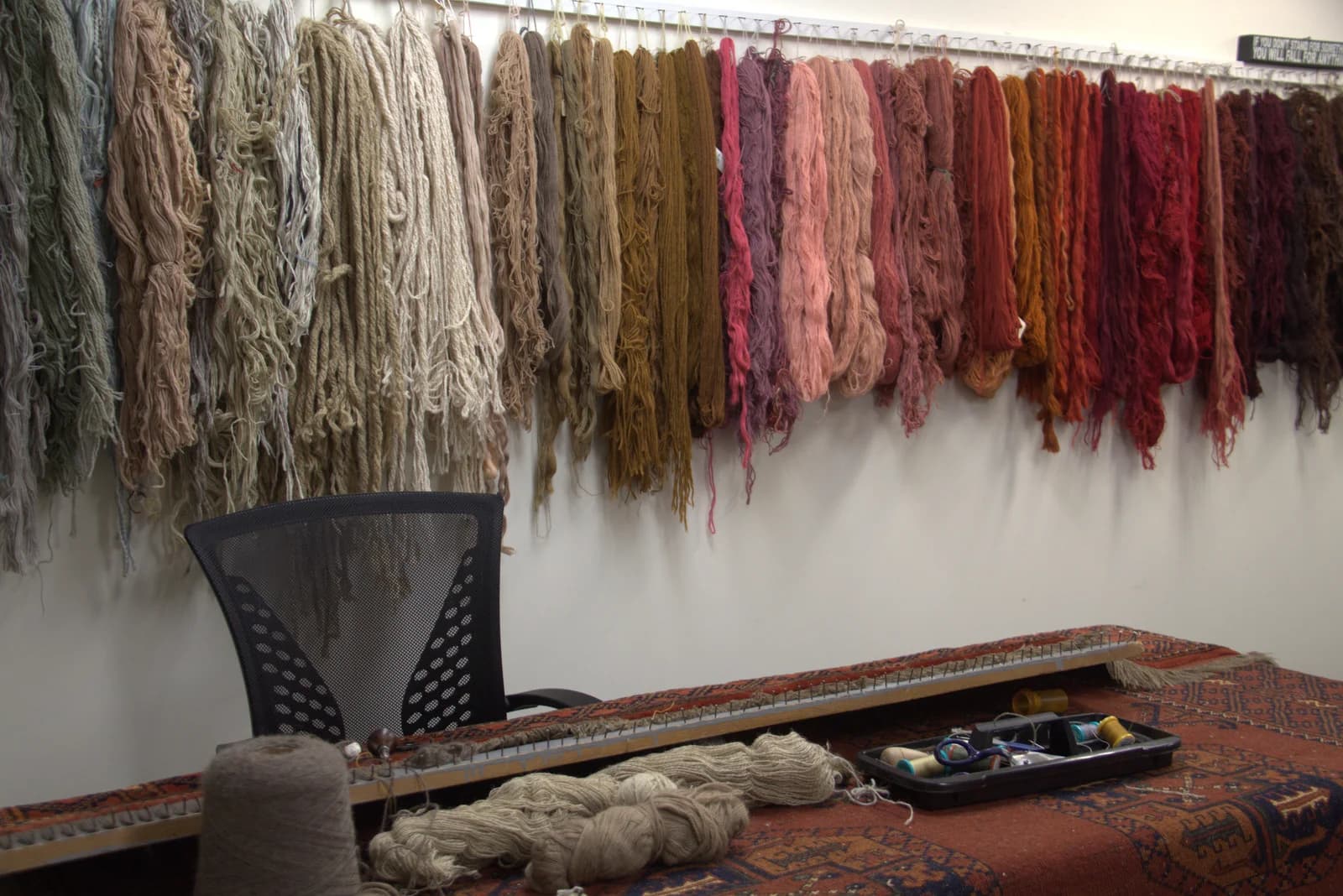
Hand-dyed wool skeins on the colour-matching wall above a repair workbench at Ahmadi Rug's Skokie workshop
  • 5.0 ★Google · 79 reviews
  • IICRCCertified firm
  • 3rd-GenFamily conservators
  • FreeWritten assessment
  • 10,000 sq ftSkokie workshop
Free insured pickup

Free insured pickup from Chicago, the North Shore, and surrounding suburbs

We collect your rug, repair it in our Skokie workshop, and deliver it back wrapped and groomed — pickup and delivery are always free and fully insured. Choose your area for local detail, or call (847) 440-1349 to schedule.

Repair that holds up because it was done right

A good rug repair should be invisible — and it should still be invisible, and still holding, ten years later. That only happens when the repairer matches the original fibre, the original dye, and the original knot structure, and reweaves by hand into the rug’s own foundation. The alternative — a glued patch, a sewn-on fringe, an overseas drop-ship — looks fine on the day and fails within a season. Here is exactly what conservation-grade repair involves, and why each step matters.

01

Assessment & damage mapping

Every rug is logged and photographed front and back at intake. We map each area of concern — worn ends, open holes, thin pile, foundation breaks, moth grazing, dye bleed — and test the foundation’s integrity before we quote anything. You receive a written assessment that says exactly what we recommend, what it will cost, and what we would leave alone.

Why it matters: the most expensive repair mistakes happen when someone reweaves over a foundation that should have been stabilised first. Mapping the damage — and the hidden weakness around it — is what makes the repair hold.

02

Material & dye matching

We source wool or silk that matches the original in weight, spin, lustre, and age, then match the colour from our dye library — often blending several lots to hit a faded antique tone exactly. Hand-spun, naturally dyed yarn is chosen for hand-knotted pieces; machine-spun only where the original was machine made.

Why it matters: a repair is only invisible if the new yarn ages and reflects light like the old. The wrong wool or a flat modern dye reads as a patch from across the room, even when the knotting is perfect.

03

Hand reweaving on the original foundation

Damage is rebuilt knot by knot on the rug’s own warp and weft, following the original knot type, density, and pattern. Ghorban performs the reweaving himself on anything structurally significant. A single square inch of dense reweave can take four to eight hours of handwork.

Why it matters: machine patching and glued backings fail — they stiffen, pull at the surrounding pile, and tear out within a few years. Reweaving into the original foundation restores the rug as a single continuous textile.

04

Fringe, selvedge & end finishing

If the ends or sides are damaged, they are rebuilt before the piece goes out — the warps are secured, the selvedge re-wrapped, and the fringe re-knotted or reconstructed. Otherwise the new reweaving has nothing sound to anchor to and will not last.

Why it matters: a rug unravels from its edges inward. Finishing the ends and sides is what stops a small repair from reopening — and what protects the foundation for the next generation.

05

Cleaning, final inspection & photo record

Where the rug also needs washing — almost always the case with moth, pet, or water damage — conservation-grade cleaning is coordinated with the repair so the piece is handled once. The finished rug is checked against its intake photographs, and you receive that before-and-after record with the rug.

Why it matters: a repaired rug that goes home with larvae, urine salts, or mould still in the foundation is a repair that fails. Documenting every stage also gives you the paperwork an insurer or appraiser will ask for.

The repairs we are proudest of are the ones a client can never find again. The damage is gone, the foundation is sound, and the rug looks like nothing ever happened to it.
Ahmadi Rug workshop, Skokie

When damage is extensive enough to affect the rug’s value, repair becomes full restoration, and we often pair major work with a formal rug appraisal so you know what the piece is worth before and after treatment. Where the cleanest fix is to cut a damaged section away and re-finish the edge, we handle that through rug resizing instead of a reweave.

Repairs we handle

Eight kinds of damage, each with its own correct repair

A frayed fringe is not a hole, and moth damage is not pet damage. Each kind of injury has a right sequence and a wrong shortcut.

Fringe restoration

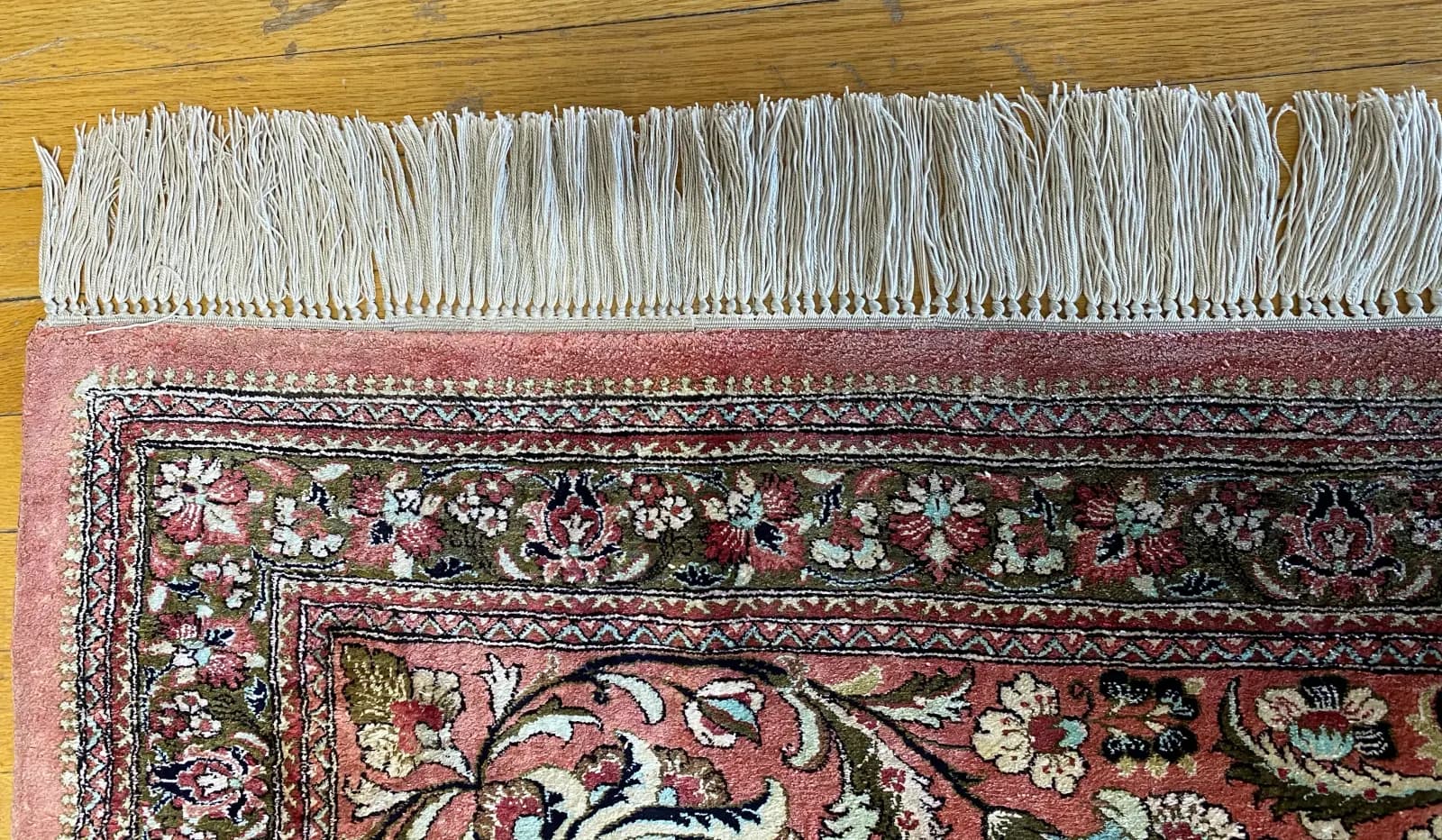
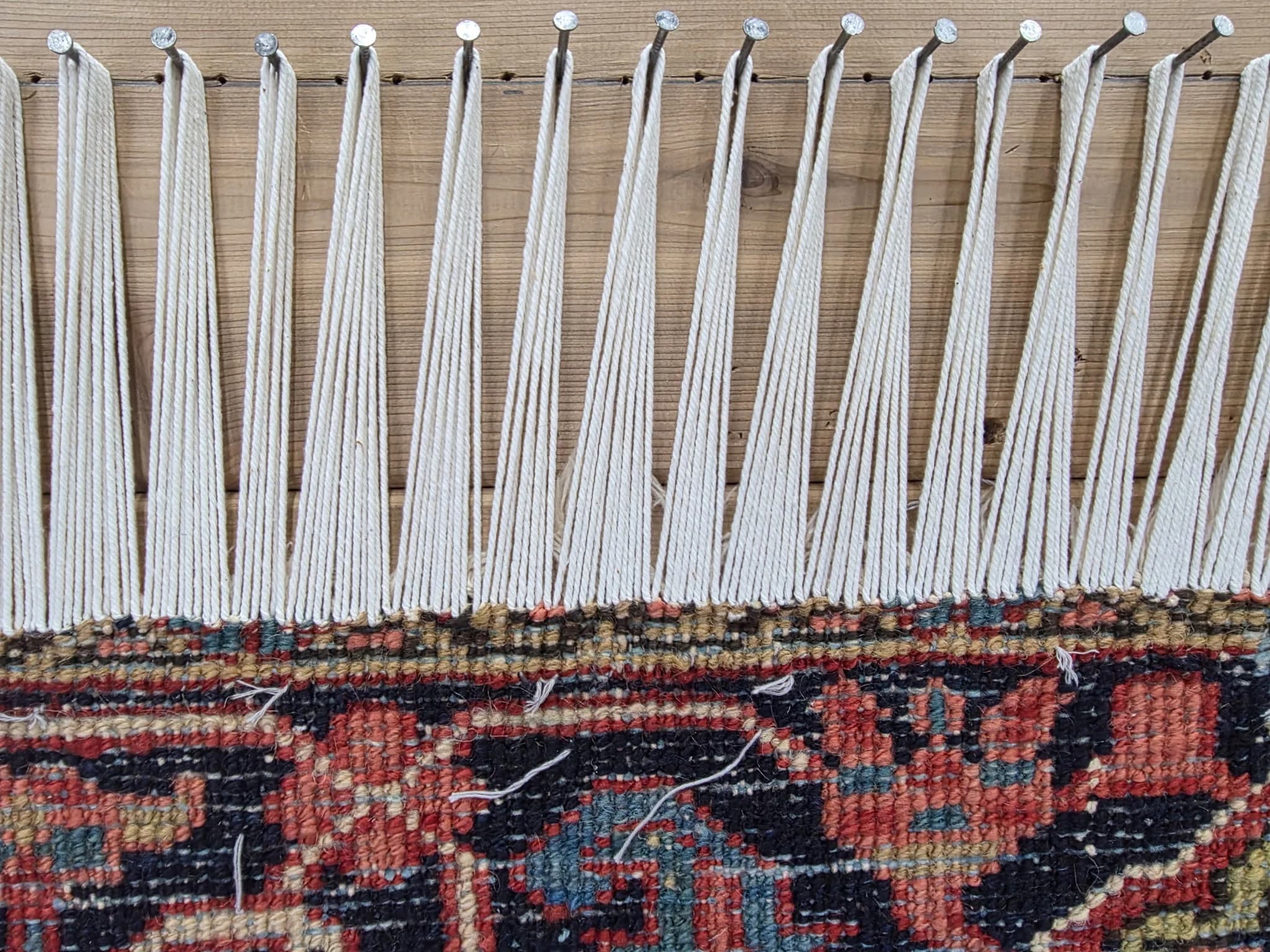
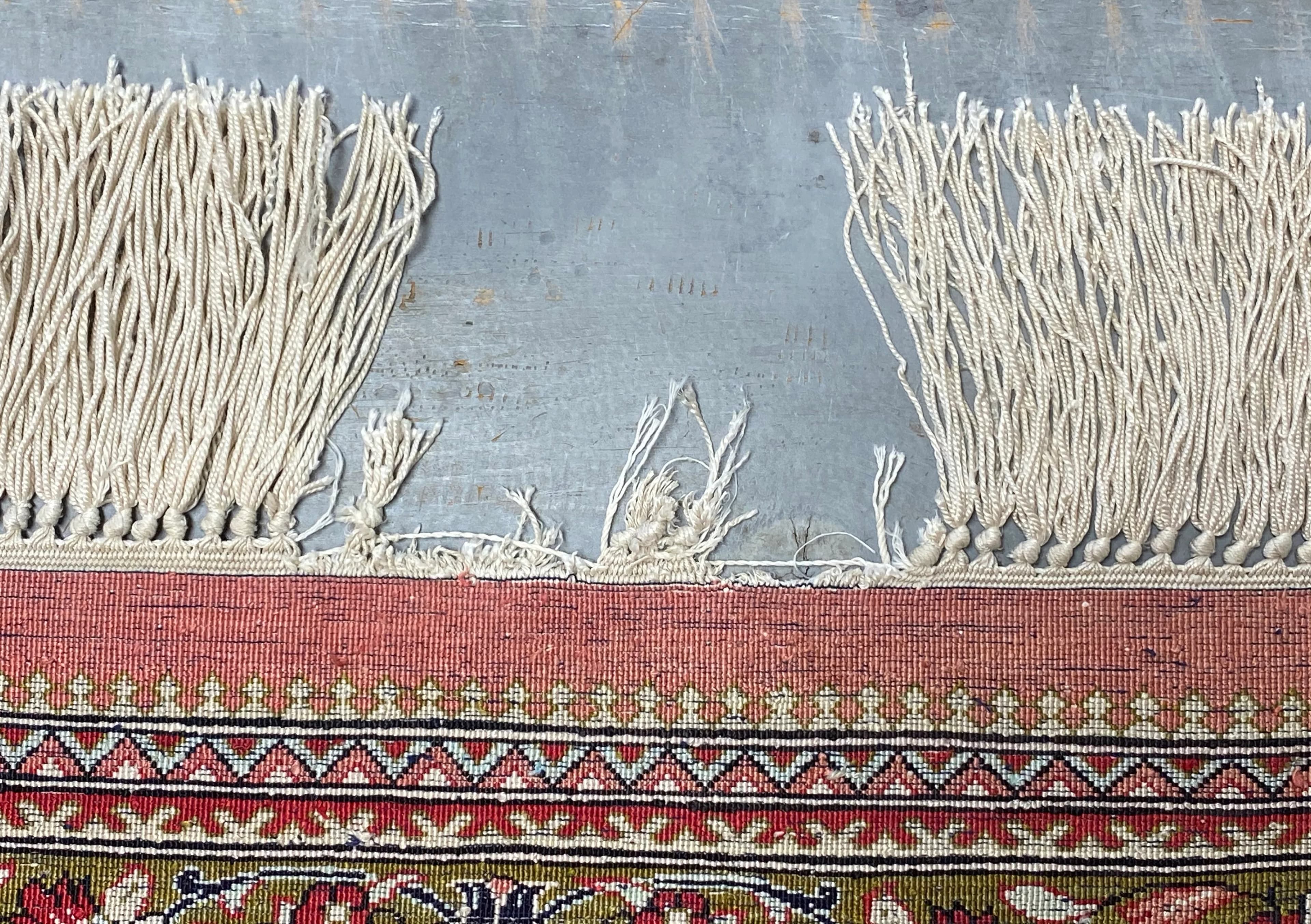
The fringe is not decoration — it is the exposed end of the rug’s warp, the structural threads the entire foundation hangs from. When fringe wears away, is chewed by a pet, or is shredded by a rotating-brush vacuum, the warp ends start to release and the rug begins to unravel from the end inward. Left alone, a frayed fringe becomes a missing border becomes a lost row of knots.

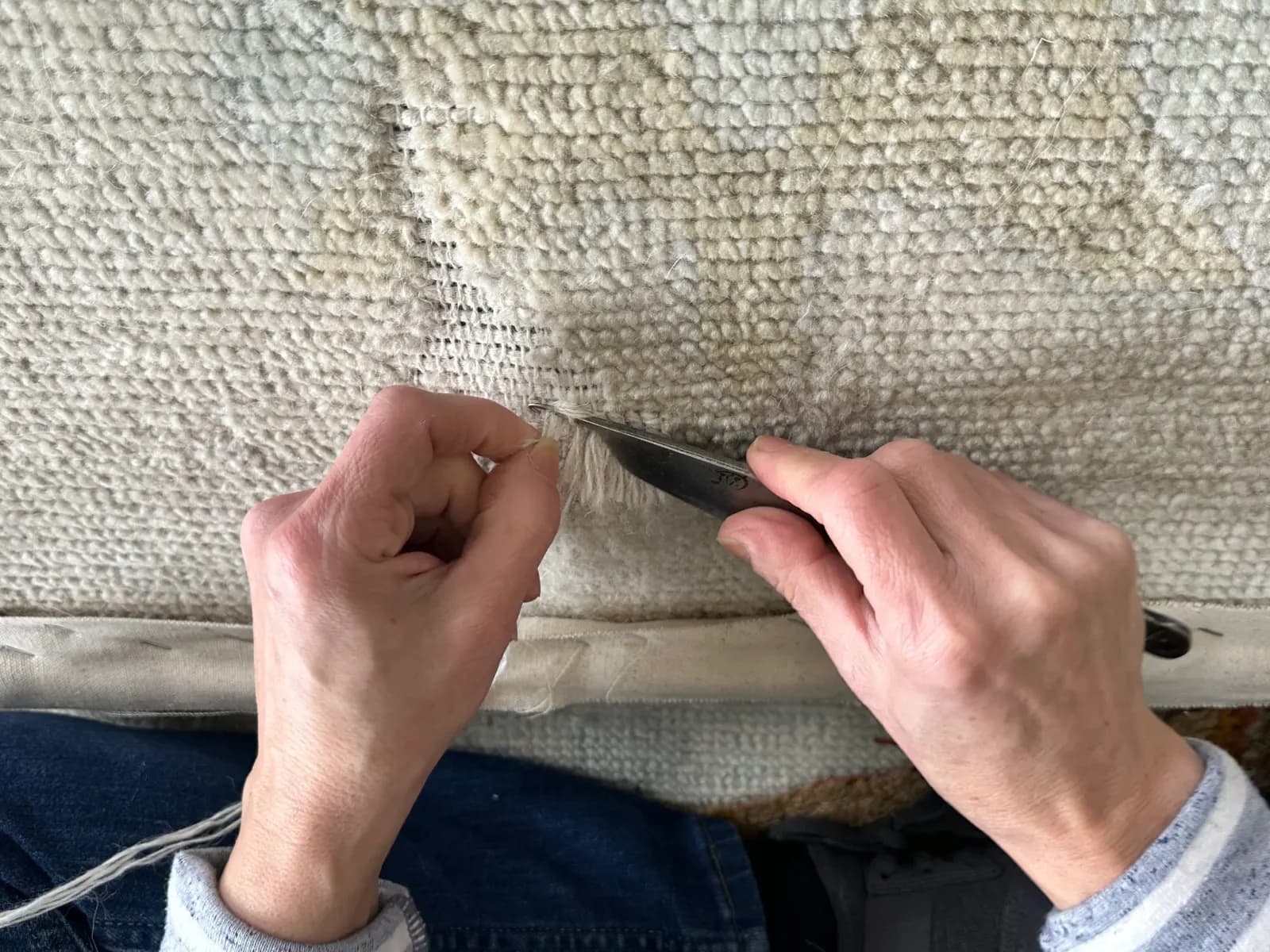
We rebuild fringe by securing the warp ends and re-knotting or reconstructing the fringe by hand, matching the original finish — whether that is a simple knotted fringe, a flat-woven kilim end, or a wrapped selvedge return. On antique pieces we reconstruct the end so it reads as original rather than added. This is hand work that cannot be shortcut with a sewn-on fringe tape, which is exactly the cosmetic fix that hides ongoing structural loss underneath.

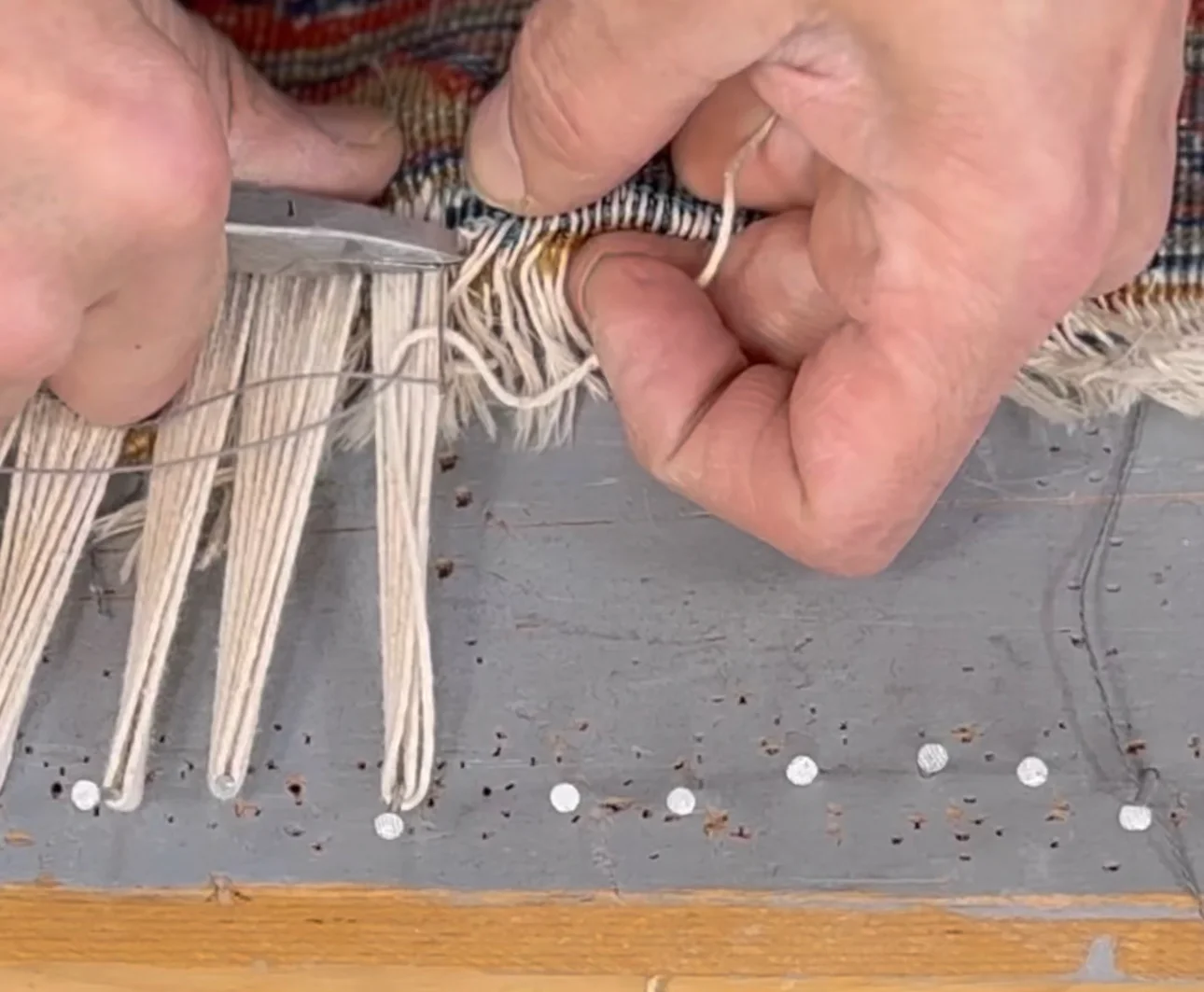
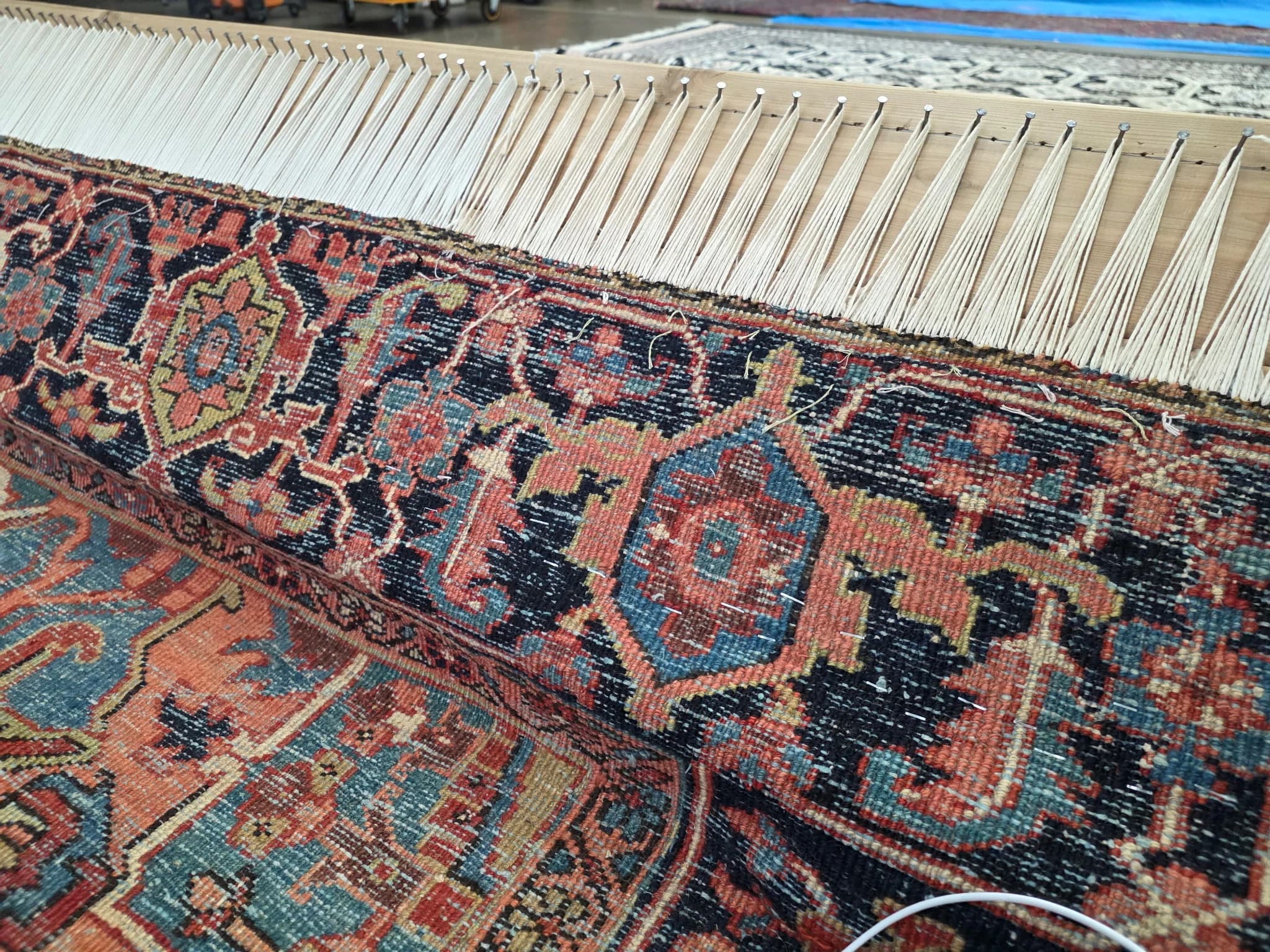
Hand re-knotting the fringe and securing the warp ends of a Persian rug — Ahmadi Rug, Chicago

Side cord / selvedge repair

The selvedge — the wrapped side cord running down each long edge — takes the heaviest mechanical stress in daily use. It is the first thing furniture legs abrade, the first thing a vacuum catches, and the first edge to go when a rug is rolled and unrolled. Once the wrapping breaks, the outermost warps are exposed and the foundation starts to open along the side.

We rebuild the side cord by re-wrapping over sound foundation warps with matched wool or goat hair, tying the new selvedge back into the body of the rug so it carries load the way the original did. Catching this early is inexpensive; ignoring it lets the damage migrate into the field, where it becomes a reweave. A re-wrapped selvedge is one of the highest-value preventive repairs we do.

Hole reweaving

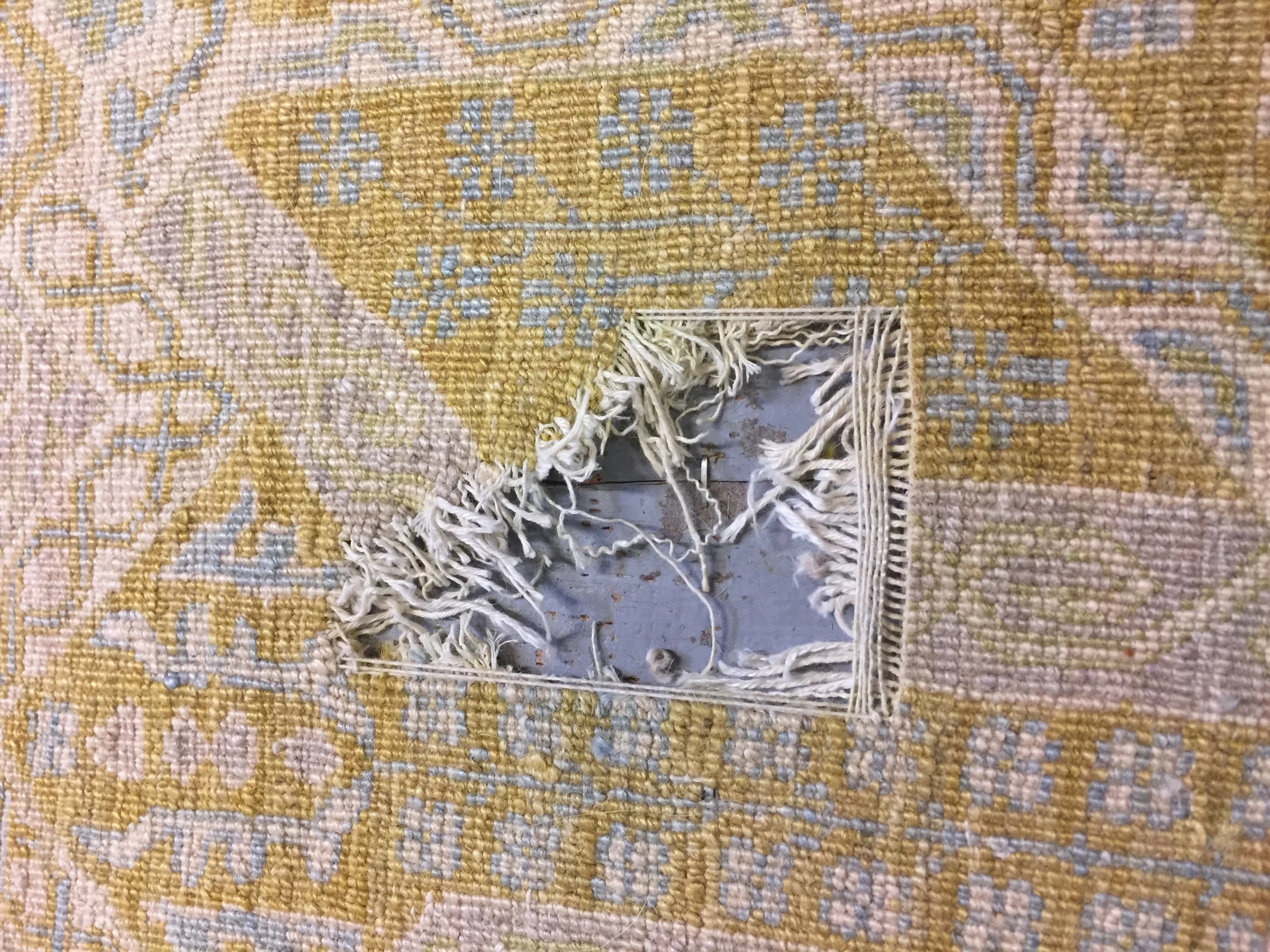
An open hole means the foundation itself is gone — not just the pile, but the warp and weft beneath it. Repairing it correctly means first rebuilding the foundation: new warp threads strung under tension, new weft woven through, and only then the pile knotted back row by row in the original design and colours. Done well, you cannot find the repair without turning the rug over and studying the back.

This is the work most often ruined by a cheap fix. A patch glued or sewn behind the hole stiffens the area, pulls against the surrounding knots, and works loose within a season. Invisible reweaving on a detailed hole routinely takes forty or more hours of handwork because every knot is placed individually to match the pattern around it — which is precisely why it lasts for decades rather than months.

Hand reweaving an open hole in an Oushak rug, rebuilding warp, weft, and pile — Ahmadi Rug, Chicago

Pile reweaving

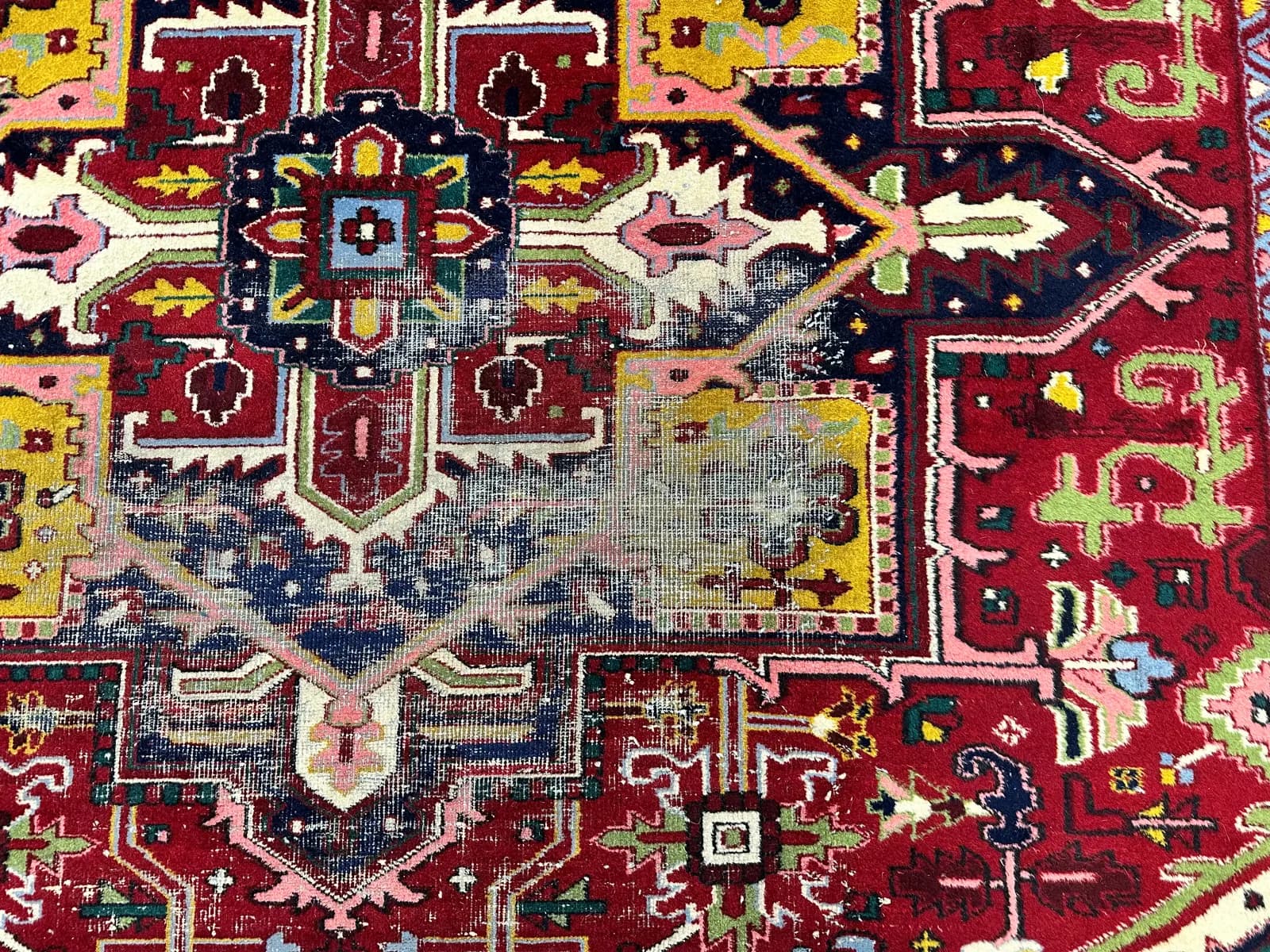
Not all damage is a hole. High-traffic paths, a favourite chair, or years of sun can wear the pile flat or thin until the foundation shows through as a pale, low patch while the surrounding rug is still deep and full. The foundation is intact, but the knots are gone. The fix is to recreate the missing pile knot by knot at the original density, so the rebuilt area sits at the same height and catches light the same way as the rest of the field.

The craft here is in the dye-matching. Old wool fades unevenly, and a worn area is usually surrounded by colours that have shifted over decades. We build the replacement yarn from multiple dye samples until the new knots disappear into the abrash — the natural colour variation — of the original. A flat single-dye match is what makes a reweave obvious; a layered, sampled match is what makes it vanish.

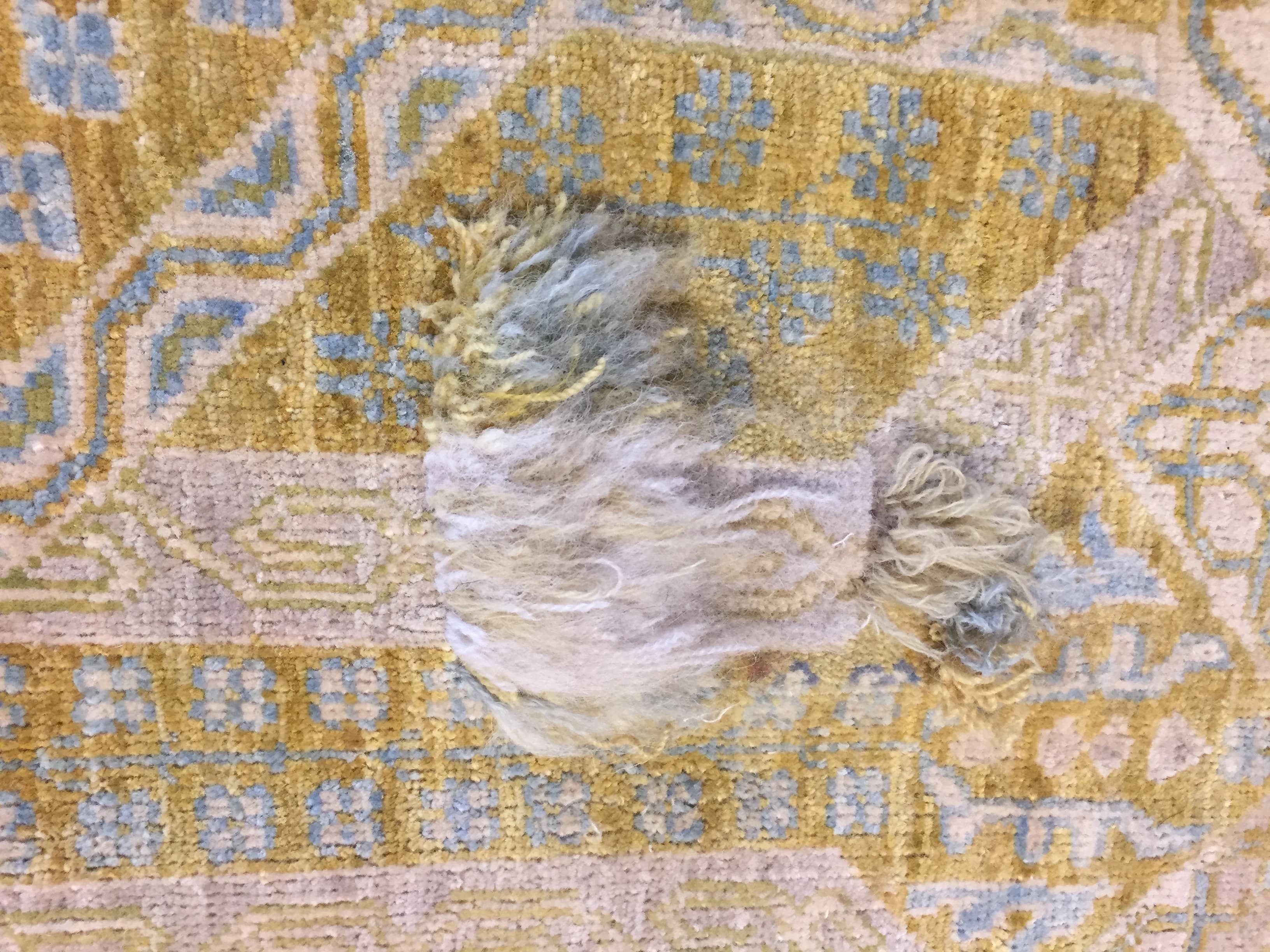
Knot-by-knot pile reweaving to rebuild a worn-flat area of an oriental rug — Ahmadi Rug, Skokie IL

Color run / dye bleeding repair

Colour run happens when a fugitive dye — almost always a deep red or navy — migrates into a lighter ground. It is caused by water: a spill left to dry, a flood, or, most often, a hot-water or high-alkaline cleaning that was never safe for a hand-knotted rug in the first place. The bleed sets as it dries, leaving a pink or grey halo around the motif.

Caught in time, migrated dye can frequently be drawn back out and the original colours re-set through controlled conservation chemistry, rather than painted over. Where a bleed has fully set, targeted dye correction rebalances the affected area. Severe or repeated bleeding is handled through our dedicated colour-correction service, often alongside the reweaving on this page.

rug color correction

Drawing migrated red dye back out of an ivory ground during color-run correction — Ahmadi Rug, Chicago

Pet damage repair

Pet damage comes in two forms, and both have to be addressed in the right order. Chewing and scratching remove pile and tear the foundation at corners and edges — a structural repair. Urine is a chemistry problem: it soaks through to the foundation, turns alkaline as it dries, crystallises into salts that rot cotton warps, and bleeds the surrounding dyes. Reweaving over a urine-saturated foundation simply rebuilds onto rotten threads.

So we clean and decontaminate first — flushing the urine salts out of the foundation through full-immersion washing — and only then rebuild the damaged structure and reweave the lost pile. Skipping the decontamination is why so many "repaired" pet-damaged rugs reopen and smell again within a year. We tell you honestly at assessment what is recoverable and what is not.

pet odor & urine removal

Moth damage repair

Clothes-moth larvae eat protein fibre, which means they graze wool pile down to the cotton foundation — often in hidden areas under furniture or along an edge that sees no light or movement. By the time the bare patches are noticed, the active infestation has usually spread. This is why "moth repair" is two jobs: first eradicate the larvae, eggs, and casings, then rebuild what they ate.

Treatment without reweaving leaves bald, structurally weak areas; reweaving without treatment puts fresh wool straight back onto a live infestation. We do both — coordinated moth treatment to stop the lifecycle, conservation cleaning to flush out eggs and frass, then knot-by-knot pile reweaving to restore the grazed areas. We currently hold position for moth-damage repair in Chicago, and it is one of the most common antique-rug rescues we take on.

moth treatment & preventionour guide to moth damage repair

Reweaving wool grazed to the foundation by moth larvae after moth treatment — Ahmadi Rug, Chicago

Water damage repair

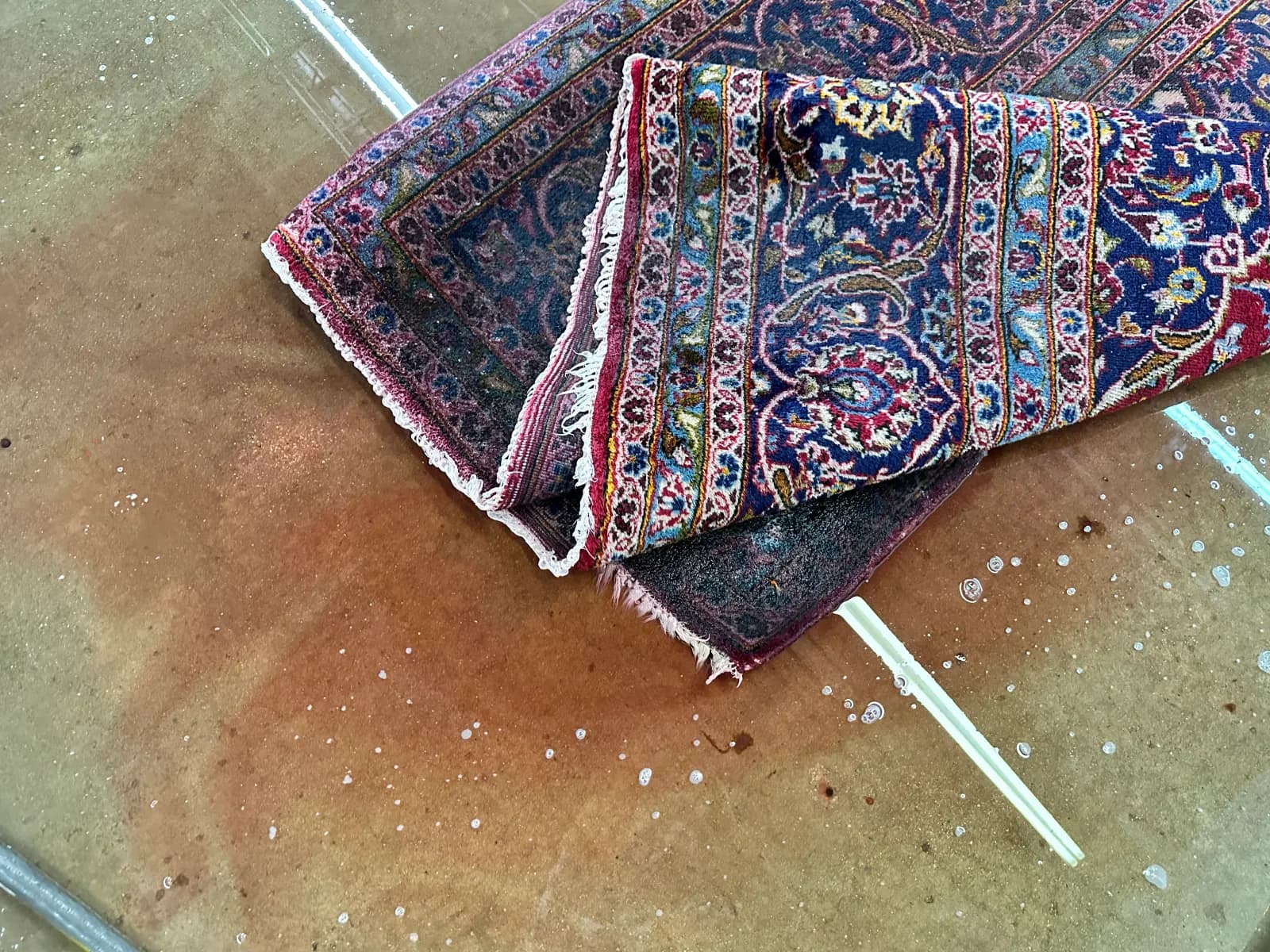
A pipe burst, an overflow, or a basement flood does layered damage to a rug all at once: the dyes bleed, the cotton foundation begins to rot wherever it stayed wet, and mould or mildew sets into the pile within days if the rug is not dried flat and fast. The visible stain is rarely the real problem — the foundation rot underneath it is.

Full water-damage recovery means stabilising and replacing rotted foundation, drawing back migrated dye, remediating mould, and reweaving any pile lost to the damage — in that sequence. Acting quickly makes the difference between a recoverable rug and a total loss, and the documentation we produce along the way is exactly what an insurance adjuster needs. If your rug has just been soaked, get it off the wet floor and call us before it dries in place.

water-damaged rug restoration

Reconstructing a corner of a rug after water damage, dye bleed, and foundation rot — Ahmadi Rug, Skokie IL
Why Ahmadi repair is different

Conservation, not cosmetics

Most rug “repair” in Chicago is cosmetic and much of it is quietly shipped overseas. Ours is conservation work, done here, by the family whose name is on the door.

  • Trained in museum conservation

    Ghorban Ahmadi trained under conservators whose work served the Louvre, British Museum, and State Hermitage collections. That is the discipline behind every repair: do as much as the rug needs and nothing it cannot withstand.

  • Conservation principles, not cosmetics

    Reversibility, matched materials, and structural integrity govern the work. A repair should be undoable by the next conservator, woven from yarn that ages like the original, and sound enough to carry load — not a glued patch that looks fine until it fails.

  • Every knot tied in-house

    Nothing is shipped to an overseas subcontractor and quietly drop-shipped back — the single biggest difference between us and most Chicago "repair" listings. Your rug is reweaved here, by our own hands, and never leaves our custody.

  • A 10,000 sq ft Skokie workshop

    The space, the dye library, the wash floor, and the drying racks are all under one roof, so cleaning, decontamination, and reweaving are coordinated on a single piece without it ever leaving the building.

  • Photographed at every stage

    You receive a before, during, and after photo record with the rug — the documentation an appraiser or insurer asks for, and the proof that the repair was done the way we said it would be.

Case studies

Rugs other people had written off

Three real recoveries from the workshop. Names and rooms kept general; the work is exactly as it happened.

Multi-rug antique recovery · Kenilworth

A collection of antique rugs, recovered from an attic

Before
After

A Kenilworth family discovered that several antique rugs, rolled and stored in their attic for years, had been quietly eaten by clothes moths the whole time. The damage ran across the collection at varying severity — some pieces lightly grazed, others with bare patches down to the foundation and ends that had begun to unravel where the wrapping had failed.

The work was staged across the collection. Every piece first went through conservation-grade cleaning to flush out moth larvae, eggs, casings, and decades of accumulated attic dust — a step that has to come before any reweaving so fresh wool is never knotted onto a live infestation. Several rugs then needed end reweaving, with fringes and selvedges reconstructed to stop the unravelling. The most damaged pieces required pile reweaving knot by knot in the grazed areas, dye-matched to colours that had shifted over a century. Finally, the fragile foundations were stabilised with a full preservation treatment to halt further deterioration.

It was a multi-month project — conservation work of this scope cannot be rushed without risking the very pieces it is meant to save. The outcome was a collection returned to its true value: not only the antique-market worth recovered and protected, but the family and heirloom value of rugs that had been written off as beyond saving.

Antique Persian Kashan · Gold Coast

Silk highlights, rebuilt after moth damage

Before
After

An interior designer brought us an antique Persian Kashan from a Gold Coast residence with a roughly two-by-two-foot area where moth larvae had destroyed the silk highlights, leaving the field around them intact but the detail gone. Silk reweaving is among the most demanding repairs in the workshop — the fibre is fine, lustrous, and unforgiving, and the original colours had aged into subtle, hard-to-read tones.

The colour was matched from several dye samples until the replacement silk read as original under the light, then the highlights were rebuilt knot by knot at the rug’s original density. The reweave ran about eight weeks. Returned to the designer, the repaired area disappeared into the pattern — invisible to the client, and to the room.

Silk Qum · Winnetka

A silk Qum after a burst pipe

Before
After

A burst pipe in a Winnetka home soaked a fine silk Qum and left it sitting wet long enough to do real structural harm. By the time it reached us the corner foundation had begun to rot, deep dyes had bled into the lighter ground, and mould had taken hold in the saturated area.

Recovery ran in sequence: mould remediation first, then the rotted corner foundation rebuilt and stabilised, the migrated dye drawn back and the affected colours corrected, and finally the lost pile rewoven to match. The full restoration took about twelve weeks. The documentation produced at each stage supported the homeowner’s insurance claim — and the Qum, written off as ruined the day the pipe failed, went home whole.

Pricing

What rug repair costs in Chicago

Repair pricing reflects the hours of hand labour required. Small repairs start at $85 — typical projects range from $500 to $2,000 — and major restoration can reach $10,000+ on antique pieces or multi-rug recovery work. Five things move the number:

  • Damage type & scope

    A re-wrapped selvedge is a different job from an open hole or a metre of grazed pile. Scope — how much area, how many separate repairs — is the largest single driver of price.

  • Materials needed

    Wool, silk, and custom-dyed yarn matched to a faded antique cost very differently. Silk and multi-lot dye matching sit at the top of the range.

  • Hours of hand labour

    Repair is priced in hours, not square feet. A single square inch of dense reweave can take four to eight hours, so detailed pattern areas cost more than open fields.

  • Conservation complexity

    Foundation stabilisation, reversibility, and matching an antique’s irregular knotting add time and skill beyond a straightforward modern repair.

  • Whether cleaning is also needed

    Moth, pet, and water damage almost always require decontamination or washing before reweaving — coordinated in-house, but part of the estimate.

Every repair receives a free written assessment before any work begins. We do not give an estimate until we have examined the rug in person at our workshop — a repair quote from a photo alone is a guess, and guesses are how people get surprised.

Turnaround

How long repair takes

We never rush conservation work. Rushed repairs fail — and a rug that has lasted a century deserves the weeks it needs.

  • Small repairs
    2–4 weeks

    Fringe, side cord, small patches.

  • Major repairs
    4–12 weeks

    Hole and pile reweaving, by area and complexity.

  • Complex restoration
    3–6 months

    Antique reconstruction and multi-rug recovery.

Insurance claims

Working with insurance on rug damage claims

When a covered loss damages a rug, the rug is often worth far more than the adjuster realises — and the difference comes down to documentation. We produce the paperwork a claim needs and work the process with you so the settlement reflects the real value of the piece.

  • Formal written assessment reports, itemising damage and recommended treatment.
  • Chain-of-custody photography documenting the rug at every stage of repair.
  • Direct coordination with adjusters when you authorise it.
  • A formal valuation through our appraisal service where a claim needs one.

Common covered scenarios include water damage from a pipe burst or flood, fire and smoke, certain pet-damage claims, theft, and transport damage. For the valuation an adjuster needs, see our rug appraisal service.

Rugs we repair

We repair every type of hand-knotted rug

From a village Kazak to a fine silk Qum, each tradition has its own wool, dye, and weave — and its own correct repair.

  • PersianTabriz, Kashan, Heriz, Kerman, Isfahan, Qum, Nain, Sarouk, Bidjar, Mashhad
  • TurkishHereke, Oushak, Konya
  • CaucasianKazak, Shirvan, Karabagh
  • MoroccanBeni Ourain, Boucherouite
  • TibetanWool and wool-silk knotted pile
  • IndianAgra, Jaipur
  • ChineseArt Deco, Peking
  • ArmenianAntique and tribal weavings
  • AfghanBokhara, tribal Baluch
  • PakistaniBokhara and fine hand-knotted
From the workshop

Before & after

Real rugs, real homes across Chicago and the North Shore. Photos are being matched from the workshop archive.

  • Tabriz rug with worn, unravelling fringe before restoration — Ahmadi Rug, Lake Forest ILBefore
    Tabriz rug with hand-reconstructed fringe and secured warp ends after restoration — Ahmadi Rug, Lake Forest ILAfter
    Tabriz
    Fringe restoration
    Lake Forest
  • Oushak rug with an open hole exposing the foundation before reweaving — Ahmadi Rug, Gold Coast ChicagoBefore
    Oushak rug with invisibly rewoven pile matching the original pattern after repair — Ahmadi Rug, Gold Coast ChicagoAfter
    Oushak
    Hole reweaving
    Gold Coast
  • Wool antique Persian rug grazed to the foundation by moth larvae before repair — Ahmadi Rug, North Shore ChicagoBefore
    Wool antique Persian rug with rewoven pile after moth treatment and repair — Ahmadi Rug, North Shore ChicagoAfter
    Antique Persian
    Moth damage repair
    North Shore
  • Before
    After
    Silk Qum
    Water damage repair
    Winnetka
  • Before
    After
    Heriz
    Pet damage repair
    Lincoln Park
  • Worn, unravelling end of an antique Persian rug with exposed warp threads before reconstruction — Ahmadi Rug, Skokie ILBefore
    Antique Persian rug with hand-rebuilt warp ends and reconstructed fringe after restoration — Ahmadi Rug, Skokie ILAfter
    Antique Persian
    End & foundation reconstruction
    Skokie
Reviews

What our clients say.

★★★★★
5.0 · 79+ Google reviews
  • ★★★★★
    I can't speak highly enough of Bobby and Ahmadi Rug! Before we called, we had significant damage to our handmade wool rugs from small clothing moths. I called several rug cleaning services and none came close to the level of expertise, service, and kindness I experienced with Bobby. They look great now and I'm so happy.
    Linda Braasch
    Chicago
  • ★★★★★
    Wonderful! My handmade rug was restored and cleaned beautifully after having been on my floor for over 20 years with pets. The sides had been damaged from cats and the fringe was uneven. I had almost considered it beyond repair and was so surprised when it was rolled out in front of me.
    Deborah Kraak
    Chicago
  • ★★★★★
    Highly recommend for silk rug cleaning! We had a silk rug that needed a deep clean as well as glue removal and we could not be happier with the results. Bobby was very communicative throughout the whole process and answered questions as needed!
    Heather Arden
    Chicago

Common questions

  • How much does rug repair cost in Chicago?

    Small repairs — a fringe, a side cord, a small patch — start at $85. A typical repair project runs $500 to $2,000, priced by the hours of handwork involved rather than by square footage. Major restoration on an antique piece or a multi-rug recovery can reach $10,000 or more. Every repair receives a free written assessment before any work begins, so you approve the price first.

  • Can moth damage be repaired invisibly?

    In most cases, yes — provided the foundation under the grazed area is still sound. We first eradicate the larvae, eggs, and casings and clean the rug, then reweave the lost pile knot by knot, dye-matched to the surrounding colours. Once the new wool is in and groomed, the repair typically disappears into the pattern. We assess foundation integrity first and tell you honestly what is recoverable.

  • How long does rug repair take?

    Small repairs such as fringe and patches take about 2 to 4 weeks. Major repairs like hole and pile reweaving run 4 to 12 weeks depending on area and complexity. Complex restoration of an antique or a full reconstruction can take 3 to 6 months. We never rush conservation work — rushed repairs fail — and we give you a realistic timeline in the written assessment.

  • Do you offer free pickup for repair?

    Yes. We provide free insured pickup and delivery throughout Chicago and the North Shore — Lincoln Park, Gold Coast, Skokie, Evanston, Wilmette, Winnetka, Glencoe, Highland Park, Lake Forest, Northbrook, and Glenview — plus western suburbs including Hinsdale, Oak Park, and Naperville. We roll the rug properly and photograph it for chain-of-custody.

  • Are you IICRC certified?

    Yes, Ahmadi Rug is an IICRC-certified firm. Beyond certification, our repair methods follow textile-conservation practice — the discipline Ghorban Ahmadi trained in under conservators whose work served the Louvre, British Museum, and State Hermitage collections.

  • Can you reweave a hole in a Persian rug?

    Yes — hole reweaving is core repair work. We first rebuild the missing foundation with new warp and weft under tension, then knot the pile back row by row in the original design and colours. Done correctly, the repair is invisible from the front and only findable on the back. A detailed hole can take 40 or more hours of handwork, which is what makes it last.

  • What is the difference between rug repair and restoration?

    Repair is targeted — fixing a specific hole, fringe, selvedge, or worn area. Restoration is comprehensive conservation of a whole piece whose condition or value calls for it: foundation stabilisation, extensive reweaving, colour work, and preservation treatment together. Many jobs start as repair and stay there; we recommend full restoration only when the damage is extensive enough to affect the rug’s value, and we will tell you which is appropriate before work begins.

  • Can you repair an antique rug?

    Yes — antique and heirloom rugs are a core specialty. They are treated as conservation objects: closer assessment, hand-spun and naturally dyed matched yarn, reversible techniques, and slower, more careful handwork than a modern rug receives. This is the work Ghorban trained for under museum conservators, and it is the kind of piece we most often recover.

  • Do you guarantee your repair work?

    Yes. Every rug is checked against its intake photographs before it leaves and returned with that before-and-after photo record. We stand behind the result, and our zero-complaint record across three generations is something we protect on every single job. If anything about the repair is not what you expected, we will address it.

  • Will the repair be visible?

    On hand reweaving, the goal is that it is not. A repair becomes invisible when the new yarn matches the original in fibre, spin, lustre, and dye, and when the knotting follows the original structure — so the rebuilt area ages and catches light like the rest of the rug. A visible repair is almost always the result of the wrong wool or a flat single-dye match, which is exactly what we avoid.

  • Can you repair silk rugs?

    Yes. Silk reweaving — on a Qum, a Hereke, a Kashmir, or the silk highlights of a fine city Persian — is among the most demanding work in the workshop because the fibre is fine, lustrous, and unforgiving and the colours are subtle. We dye-match silk from multiple samples and rebuild at the original knot density so the repair disappears into the pattern.

  • Do you work with insurance companies?

    Yes. We provide formal written assessment reports, document the rug with chain-of-custody photography at every stage, and work directly with adjusters when you authorise it. Water damage, fire and smoke, certain pet-damage scenarios, theft, and transport damage are common covered claims. For the valuation an adjuster needs, we coordinate with our rug appraisal service.

  • Can you fix a rug damaged by water?

    Yes — but act quickly. Water brings three problems at once: dye bleed, foundation rot wherever the rug stayed wet, and mould within days. Recovery runs in sequence: mould remediation, foundation stabilisation, drawing migrated dye back, and reweaving lost pile. Getting the rug off the wet floor and to us before it dries in place is what makes it recoverable rather than a total loss.

  • Can you repair a heavily damaged Persian rug?

    Often, yes — we routinely recover pieces that owners had written off. The deciding factor is the foundation: if enough sound warp and weft remain to rebuild onto, even extensive pile loss, multiple holes, and damaged ends can be rewoven. We assess the foundation first and give you an honest answer, including when a piece is better served by full restoration.

  • What if the damage is too severe to repair?

    We will tell you plainly. When a foundation is too far gone to rebuild onto, we say so rather than taking on work that will fail. In those cases there are still good options — sometimes cutting the sound portion down and re-finishing it through resizing, sometimes a formal appraisal for an insurance total-loss claim. Honesty here protects you, and it is why our complaint rate is zero.

  • Do you also clean the rug during repair?

    When it is needed — and with moth, pet, or water damage it almost always is — yes. Conservation-grade cleaning and decontamination are coordinated in-house with the repair so the rug is handled once and reweaving never goes onto a contaminated foundation. Cleaning is quoted as part of the assessment.

  • Can you match the original dyes?

    Yes, and it is where much of the craft lives. Old wool fades unevenly, so we build the replacement yarn from several dye samples until it disappears into the abrash — the natural colour variation — of the original. A flat single-dye match is what makes a reweave obvious; a layered, sampled match is what makes it vanish.

  • What is the difference between hand-knotted and machine repair?

    Hand repair rebuilds the rug as a continuous textile — new knots tied into the original foundation, ageing and wearing with the rest of the piece. Machine patching glues or sews a separate piece behind the damage; it stiffens, pulls at the surrounding pile, and works loose within a few years. On a hand-knotted rug, only hand reweaving lasts. We do not machine-patch heirloom pieces.

  • How do I prepare my rug for repair pickup?

    Very little is needed. Remove furniture from the rug if you can, and note the specific damage or problem areas so we flag them at intake. Leave the rolling and wrapping to us — rolling a dry or brittle foundation the wrong way can crack it, so we handle that on site. If the rug is wet from a leak or flood, do not let it dry folded; call us first.

  • Should I attempt a DIY repair first?

    For anything beyond a loose thread, no. Iron-on patches, fabric glue, and sewn-on fringe tape all stiffen the rug, pull at the surrounding knots, and usually make the eventual professional repair larger and more expensive. The single most valuable thing you can do yourself is stop the damage from spreading — keep the rug off the wet, out of the sun, and away from the pet — and get a written assessment early.
Service area

Serving Chicago and the North Shore

Ahmadi Rug provides rug repair for homeowners and interior designers across Chicago and the North Shore. We offer free insured pickup and delivery from Lincoln Park, Gold Coast, Evanston, Wilmette, Winnetka, Glencoe, Lake Forest, Highland Park, Northbrook, Glenview, and Skokie — as well as western suburbs including Hinsdale, Oak Park, and Naperville.

Repair and reweaving timelines depend on damage extent — small repairs run 2–4 weeks, major reweaving 4–12 weeks, and complex antique restoration 3–6 months. We give a realistic timeline in the free written assessment.

To schedule a free pickup from anywhere in our service area, call (847) 440-1349 or submit an estimate request online.

Free written assessment

Your rug is more recoverable than you think.

Send a photo or book a free insured pickup from anywhere in Chicago or the North Shore. We examine the rug, give you a written assessment, and only then quote the work.

  • 5.0★Google · 79+ reviews
  • RICARUG Index Certified
  • FreeInsured pickup
Request an estimate

Tell us about your rug

Free download

The Rug Owner’s Care Guide

10 pages covering fiber care, rotation schedules, spill response, moth prevention, and when to call a professional. Written by Ghorban from 40 years of conservation work.

No spam. Unsubscribe any time.

CallTextEstimate