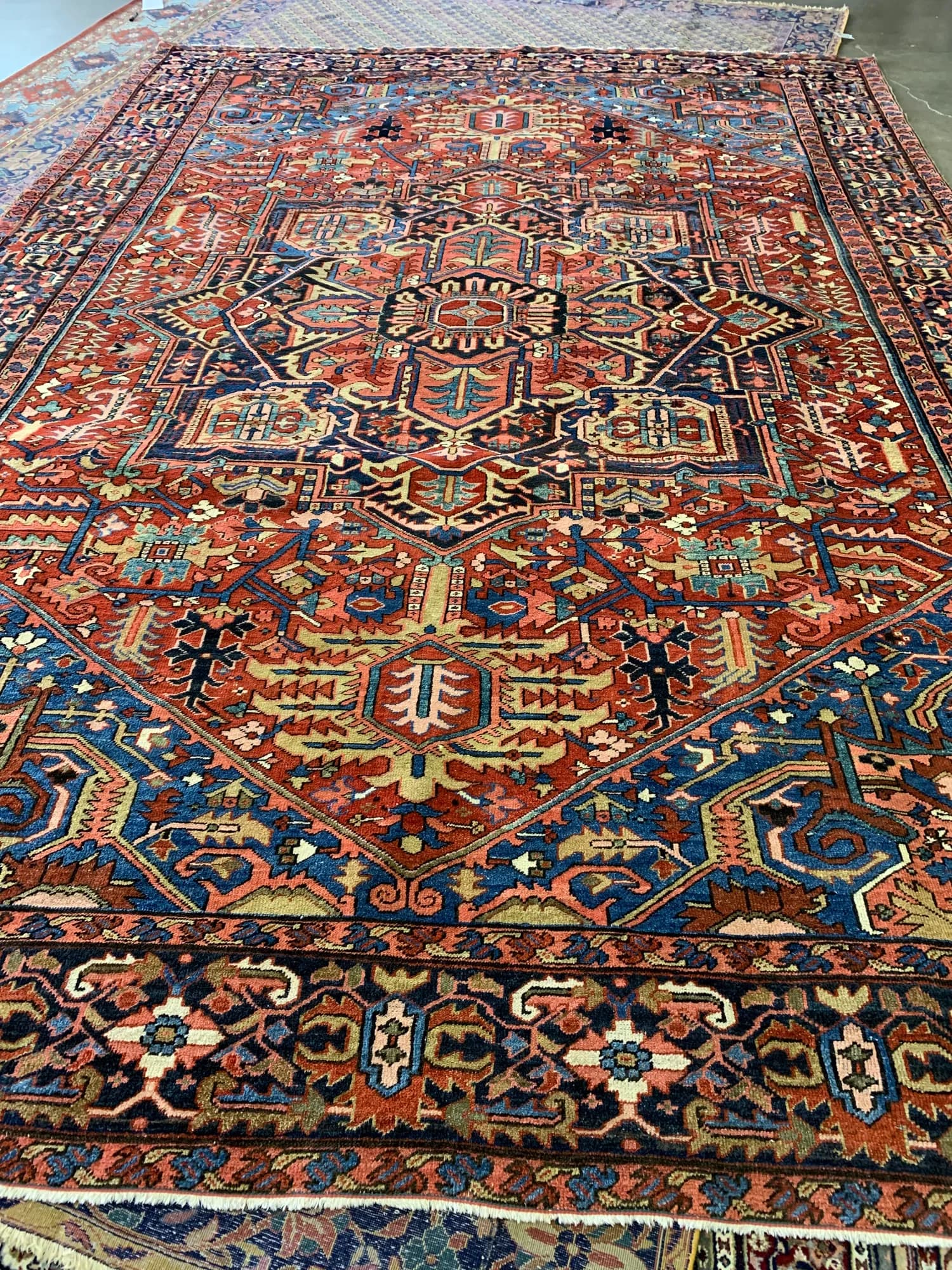
Three distinct Chinese traditions
Chinese export rugs are usually sorted into three periods and workshops that each behave differently under cleaning:
- Peking rugs (c. 1870–1920). Deep pile, traditional Chinese motifs (dragons, floral medallions, cloud bands), often on cotton foundations with wool pile. Natural dyes predominate, more stable.
- Art Deco Chinese (c. 1920–1940). Bold modernist compositions influenced by French Art Deco design. Walter Nichols and Fette-Li are the most collector-recognized workshops. Many used early synthetic dyes that varied in color-fastness — the reason dye testing matters more on these pieces than on most Persians.
- Nichols sculpted-pile rugs. A subset of the Art Deco period where the pile was cut into low relief after weaving, producing a three-dimensional surface. Beautiful and more common as American imports than most people realize. These need specialized handling.
Why early synthetic dyes matter
Between roughly 1890 and 1935, Chinese workshops shifted from natural dyes (indigo, madder, sophora) to early aniline synthetics. Some of those synthetic dyes — particularly the pinks and corals and certain cobalt blues — were poorly fixed and bleed readily in water. A carpet cleaner treating an Art Deco Chinese rug with truck-mounted hot-water extraction has a strong chance of producing a pink field where there used to be ivory.
Dye testing is not optional on any piece from this era. We test every visible color on every Chinese antique before any full immersion. Natural-dye Pekings are more forgiving but still tested. The broader case for why dye testing matters is in how a museum conservator cleans a rug.
Sculpted-pile considerations
Nichols sculpted-pile rugs have the decoration carved into the pile after weaving. The sculpt direction matters for appearance — light catches the pile differently from different angles. During cleaning, the pile has to be groomed back into its original sculpt direction before drying, or the rug loses the three-dimensional effect.
Full sculpt restoration on heavily worn pieces is possible but priced separately and not included in a standard cleaning. We will tell you whether a sculpt refresh is worth doing before the work begins.
Silk blends
A significant share of Chinese export rugs use silk accents or are full silk-blend pieces, particularly later Art Deco work and anything destined for the US luxury market. Silk changes everything about the cleaning chemistry and drying. The argument for that is in silk rug cleaning. We check for silk on every Chinese antique that comes in — occasionally we find it where the client did not know it was there.
Appraisal first, cleaning second
If you are not certain what you have, we recommend a RICA-certified appraisal before cleaning an antique Chinese rug. Condition matters for value; so does documented provenance. A pre-cleaning appraisal establishes both. Fees for an insurance-schedule appraisal start at $150 — details on how much rug appraisal costs in Chicago.
Cost reference
- Peking wool rug 8×10: from $5/sq ft, final price after assessment
- Art Deco or Nichols, standard pile: from $5/sq ft, final price after assessment
- Sculpted-pile sculpt refresh: quoted after inspection
- Silk-blend Chinese: premium pricing, written estimate after assessment
- Insured pickup and delivery is free within 5 miles of our Skokie workshop and $75 round trip beyond.