
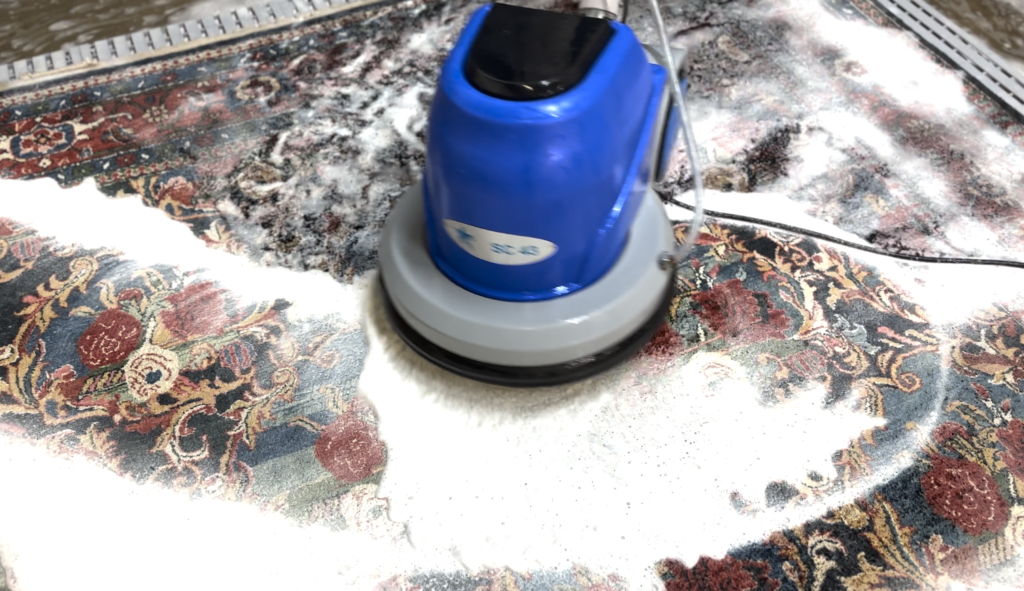
When you search for Oriental rug cleaning nearby, you’ll find carpet cleaners, dry cleaners, and specialist conservators all competing for the same query. How you choose between them will determine whether your rug looks better — or becomes permanently damaged.
What makes Oriental rug cleaning different
The phrase “Oriental rug” covers a broad category: hand-knotted rugs produced in Iran (Persian), Turkey, Afghanistan, India, Pakistan, China, and Central Asia. What these rugs share — and what makes their care fundamentally different from machine-made carpets — is their construction.
A hand-knotted Oriental or Persian rug is built on a foundation of warp threads (running the length of the rug) and weft threads (running the width). Pile knots are tied individually around pairs of warp threads — in a fine Persian rug, there may be 300 or more knots per square inch. The dyes are typically natural or early synthetic compounds that behave differently from modern carpet dyes under moisture and heat. The wool itself is often lanolin-rich and responds to washing in specific ways that require careful chemistry management.
None of this is accounted for in standard carpet cleaning protocols. And when those protocols are applied to hand-knotted rugs, the results range from disappointing to irreversible.
Can you steam clean an Oriental rug?
This is one of the most commonly searched questions about Oriental rug care — and the answer is unambiguous: no.
Steam cleaning, technically called hot-water extraction, involves forcing heated water mixed with cleaning solution into the rug pile under pressure, then extracting it with vacuum suction. The problems it creates on hand-knotted rugs are well-documented:
- Wool shrinkage and felting. Wool fibers have a natural scale structure that causes them to tighten, mat, and felt when exposed to heat and agitation simultaneously. Once a wool rug has felted, the change is permanent — no amount of subsequent treatment reverses it.
- Dye bleeding. Natural vegetable dyes — madder red, indigo blue, pomegranate yellow — are pH-sensitive and can migrate when exposed to hot water, particularly the alkaline chemistry used in most carpet extraction systems. Dye bleed in a rug means neighboring colors bleed into each other, permanently altering the design.
- Foundation saturation. Hot-water extraction pushes moisture deep into the rug’s foundation. Without the controlled dry-down environment of a professional facility, this moisture sits in the foundation and creates conditions for dry rot, mold, and persistent odor — even if the pile appears dry.
- Soil redistribution. Extraction equipment removes surface soil effectively. Embedded dry soil in the foundation — the kind that grinds against fiber and accelerates wear — is not meaningfully addressed by extraction. Professional cleaning begins with a dry-dusting process that removes this embedded particulate before the rug ever gets wet.
What to look for when searching for Oriental rug cleaning near you
When evaluating Oriental rug cleaners near you, the right questions cut through the noise quickly:
Do they wash in a dedicated facility?
On-site cleaning cannot replicate what a professional rug washing facility does. Proper Oriental rug cleaning and rug restoration requires dusting equipment, a wash floor with drainage, controlled water temperature, pH-appropriate chemistry, extraction equipment, and a drying environment with managed airflow. A van with a hot-water extraction unit is not equivalent.
Do they dye-test before washing?
Dye stability varies dramatically between rugs — even between different colors within the same rug. A professional will test each color in an inconspicuous location before applying any chemistry. If a cleaner doesn’t mention dye testing, ask directly. A blank response is a red flag.
Can they describe their drying process?
Controlled drying — flat or gently hung, at room temperature, with monitored airflow and no forced heat — is as critical as the wash itself. Rugs dried in a heated dryer or with forced hot air experience the same fiber stress as steam cleaning. Ask where and how they dry.
Are they IICRC certified?
IICRC (Institute of Inspection, Cleaning and Restoration Certification) certification indicates formal training in fiber identification, chemistry, and cleaning methodology. It doesn’t guarantee expertise in fine Oriental rugs specifically, but it filters out operators with no technical foundation at all.
Oriental rug cleaning near Chicago and the North Shore
Ahmadi Rug is a specialist Oriental, Persian, and antique rug cleaning service based in Skokie, IL — centrally located to serve both Chicago and the North Shore. Our founder Ghorban Ahmadi is a museum-trained conservator with hands-on experience at the Louvre, British Museum, and State Hermitage. Every rug we clean is hand-washed in our 10,000 sq ft in-house facility using conservation-grade chemistry, and dried under controlled conditions.
We offer free insured pickup and delivery for Oriental rug cleaning throughout:
- Chicago
- Evanston
- Wilmette
- Winnetka
- Glencoe
- Highland Park
- Lake Forest
- Northbrook
- Lincoln Park
- Gold Coast
- Hinsdale
- Oak Brook
Persian rug cleaning near me — same standard, specific requirements
Persian rugs — those produced in Iran, including Tabriz, Isfahan, Kashan, Kerman, and tribal weaves — represent some of the most technically complex rugs in terms of cleaning requirements. The density of knotting in fine city weaves means that soil can embed at depths that standard processes don’t reach. Many Persian rugs also use a combination of wool pile and silk foundation, which requires handling both fiber types correctly in the same wash.
Our conservators assess each Persian rug individually before any cleaning begins. We evaluate pile density, fiber composition, dye stability, the condition of foundation threads, and the presence of any prior repairs or treatments that might affect how the rug responds to washing. This assessment determines the chemistry, agitation level, and drying approach for that specific piece.
Tabriz, Kashan, and Isfahan pieces arrive at our Skokie workshop in predictable patterns: pet odor that has settled into the foundation and won’t respond to household treatment; embedded dust from decades in sunlit rooms; and the occasional surprise of moth damage discovered only after the pile is inspected under proper light. In each case, the treatment is specific — foundation-level decontamination soak, controlled hand wash, and only after the rug is clean, an honest assessment of any structural work needed. A Tabriz that looked finished often has another fifty years in it.
Silk rug cleaning near me
Silk rugs — including Qom (Qum) Persian silk, Chinese silk, and wool-silk blend pieces — require the most cautious approach of any rug type. Silk is protein-based, reacts differently to pH changes than wool, and is significantly weaker when wet. The wrong chemistry on a silk rug can cause permanent fiber breakdown; the wrong drying approach can distort the pile direction irreversibly.
We clean silk and silk-blend Oriental rugs using silk-specific pH-managed chemistry, minimal mechanical agitation, and extended controlled drying. We do not use steam, extraction equipment, or alkaline solutions on silk under any circumstances. If you’re searching for silk rug cleaning near you in the Chicago area, we recommend calling before booking — we’ll ask you a few questions about the piece and confirm whether it’s a good candidate for washing or whether another approach is more appropriate.
What Oriental rug cleaning costs
Professional Oriental rug cleaning is priced per square foot and varies by fiber type and condition:
- Standard wool Oriental and Persian rugs: $3.00–$5.00/sq ft. An 8×10 typically runs $240–$400.
- Fine hand-knotted city weaves (Tabriz, Isfahan, Kashan): $4.00–$6.00/sq ft. Priced individually after assessment.
- Silk and silk-blend rugs: Quoted individually. Typically $6.00–$10.00/sq ft due to the additional care required.
- Antique and museum-quality pieces: Assessed individually. Pricing reflects both cleaning and any conservation work identified during intake inspection.
All estimates are written and firm before any work begins. Free insured pickup and delivery is included for all Oriental rug cleaning clients throughout Chicago and the North Shore.
Find Oriental rug cleaning near you — with free pickup
Share a photo and we’ll respond with an honest assessment and firm estimate within 2 hours. No obligation.
Frequently asked questions about Oriental rug cleaning
How do I know if my Oriental rug needs professional cleaning?
The clearest indicators are dull color and flattened pile — both caused by embedded dry soil that vacuuming doesn’t reach. Hold a section of the rug over a white surface and gently flex it; if fine grit falls out, the rug has significant embedded particulate that needs professional dusting and washing. Pet odor is a separate issue — it originates in the foundation and requires a decontamination soak that household methods can’t deliver.
Can I clean an Oriental rug myself at home?
Surface refreshing with a mild wool-safe shampoo and cool water is possible for lightly soiled rugs and carries low risk if you keep the rug mostly dry and allow it to dry completely in a flat, ventilated space. Deep cleaning, odor treatment, dye-related issues, and any cleaning of silk, fine Persian, or antique rugs should always be entrusted to a specialist. The cost of professional cleaning is considerably less than the cost of repairing a dye-bleed or felted border caused by an attempted home wash.
How long does Oriental rug cleaning take?
Standard Oriental rug cleaning at Ahmadi Rug is typically complete within five to seven business days from pickup, including dusting, washing, drying, inspection, and fringe detailing. Fine silk rugs or pieces requiring additional treatment may take up to ten business days. We always confirm the timeline during your free estimate.
Do you clean Oriental rugs with pet damage?
Yes. Pet urine in Oriental rugs requires a foundation-level decontamination soak followed by thorough rinsing to neutralize odor at its source. This is different from — and more involved than — standard cleaning. If a rug has been repeatedly saturated or stored damp after pet accidents, we’ll assess for dye loss and structural damage on intake and advise honestly on expected outcomes before any work begins.
